¶ Pastures and Grazing in SnapPlus Version 3
SnapPlus provides a way to document nutrients spread by grazing animals in a nutrient management plan. To start, open the grazing tab of the nutrients page. At the top of the page is a toolbar with an input dropdown and a crop year selector.
Using these input dropdown menu, create a new grazing schedule and the controls will become fully available:

One grazing schedule can extend over more than one crop year. Data entered on the grazing tab will be specific to the crop year specified in the dropdown menu. Once a schedule has been applied to fields, the text on the righthand side of the toolbar will indicate the number of acres being grazed on the farm, in the year, in both the non-grazing and grazing seasons.
¶ Grazing Schedules
¶ What's in a grazing schedule?
A grazing schedule contains important information about grazing animals:
- What kind of animals are on your pastures
- How many animals are on your pastures
- Which fields have animals grazing them
- Which months have animals grazing fields
- How much time are animals spending on the pasture
¶ Adding Animals to a Grazing Schedule
There are two ways to add animals to a grazing schedule:
- Use the + Add animals button.
- Use the Copy prior years button -- this will take any animal data you've added to the schedule in the year prior to the currently selected year in the "Crop year" dropdown and add it to the currently selected year's grazing schedule. In the above example, if our schedule “Schedule” had data for animal herds in 2024, Copy prior years would carry that information over to the 2025 schedule.
¶ Configuring animal data
When adding new animals to a schedule with method 1, a toolbar will display to allow data entry:

- Months: which months are the animals going to be on the pasture? Multiple months can be selected from this list, and animals can be removed from or added to the pasture in months after they are initially added to the schedule. At least one month must be selected before any other information can be set.
- Animal groups: what kind of animals are going on the pasture? Only one selection is possible from this menu.
- # of animals: how many animals are in this herd? Enter a number.
- % time spent on pasture: what proportion of hours in the day are these animals grazing the pasture? Options are 25%, 50%, 75% and 100%.
Once data is entered for all four options, the animal will appear in the specified month(s) in the grazing schedule visible below:
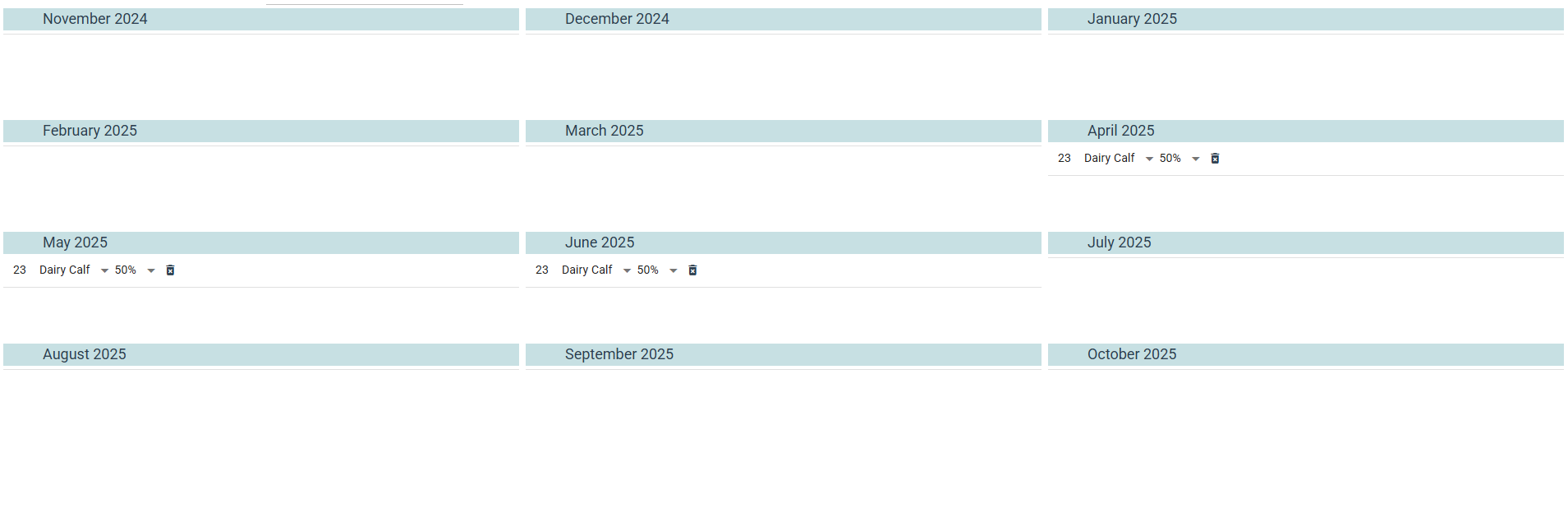
To copy an animal to another month, drag and drop the animal of choice into another month on the calendar.
¶ Editing grazing data
Data about saved animals can be modified in two ways:
- Change data for one animal herd in one month: Clicking on an animal in the calendar will allow you to change data via input. Changes will only be applied to those animals in that month. In the above example, we could change the number of animals from 23 to 24 in May 2025. Even though they were added at the same time, the change will not be applied to the animals in April and June.
- Change data for more than one month: If animals in different months share properties, they can all be modified by one set of changes. To do so, select an animal from the Configure animals dropdown near the top of the page:

Animals are grouped in this drop-down menu by the the animal group, the number of animals and the % time spent on pasture. In the current example, SnapPlus has grouped a herd of 23 dairy calves that spend 50% of their time on pasture. Changing a value here and clicking the DONE EDITING button will change the value for all animals in the herd. So, if the # of animals is changed from 23 to 24, the animals in April, May and June will all be changed in number to 24.
¶ Applying a Grazing Schedule to Fields
Once a grazing schedule has been filled out with the correct animal data, it can be applied to fields with the Apply grazing schedule button at the top of the page. This will open a pop-up window that can be used to select fields to apply the grazing schedule:
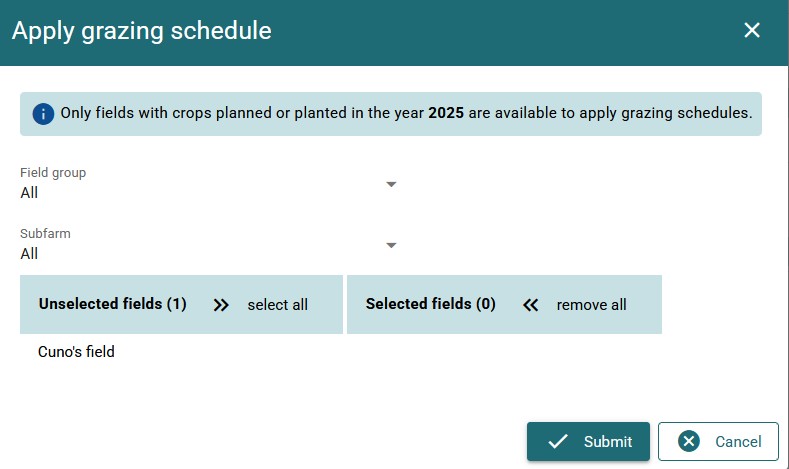
At the top of the pop-up there is an informational message: Only fields with
In this example, there are many fields on the farm, but only one has a pasture crop on it in 2025.
¶ SnapPlus supported pasture crops
The following crops are currently considered pasture crops in SnapPlus V3. The presence of one of the crops on a field in a given year will make it possible to apply the schedule for that year to that field.
- Pasture grass-legume seeding
- Small grain nurse crop to pasture grass seeding
- Small grain nurse crop to pasture grass seeding - hay cut
- Small grain nurse crop to pasture grass-legume seeding
- Pasture grass - hay cut
- Pasture grass seeding
- Pasture unimproved
- Small grain nurse crop to pasture grass-legume seeding - hay cut
- Small grain nurse crop to pasture legume more than 30% seeding
- Small grain nurse crop to pasture legume more than 30% seeding - hay cut
- Pasture grass seeding - hay cut
- Pasture grass-legume seeding - hay cut
- Pasture legume more than 30% seeding - hay cut
- Pasture unimproved - hay cut
- Pasture legume more than 30% seeding
- Pasture grass
- Pasture legume more than 30% - hay cut
- Pasture legume more than 30%
- Pasture grass-legume
- Pasture grass-legume - hay cut
¶ Animal units per acre
Once the schedule has been applied, new information will be displayed in the top right part of the page:
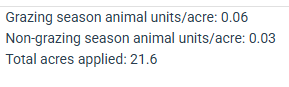
This information is also available in the Nutrient Application Planner:

The total acres applied is the sum of acres on all of the fields that are included in the grazing schedule.
Expect these values to change if the animals in the herd are modified, or if the schedule is applied on more or fewer fields.
¶ Grazing applications on the NAP
Once a schedule has been applied to fields, grazing applications will be visible in the Nutrient Application Planner.

Grazing application data will appear the same as other applications, with one entry for the non-grazing season and one for the grazing season. Rate/Acre is calculated given the animal unit density per acre specified in the schedule. Grazing applications cannot be modified or deleted from the Nutrient Application Planner -- to make changes to grazing applications, modify the schedule in the grazing tab of the nutrients page and apply the schedule to fields again . Then SnapPlus will update the applications as they are displayed here with the results of new grazing application calculations.
¶ Grazing Manure Nutrient Values
SnapPlus uses "as excreted" values when calculating the nutrient content of grazing manure applications. A summary table of these values is provided below. The nutrient values shown below are for first year available nutrients.
Grazing manure nutrients (as excreted values):
| Animal Type | N Surface (lb/ton) | P2O5 (lb/ton) | K2O (lb/ton) | S (lb/ton) | Dry Matter (%) |
| Beef, grazing | 3 | 3 | 7 | 1 | 11 |
| Chicken, pastured | 11 | 11 | 12 | 0.8 | 25 |
| Dairy, grazing | 3 | 3 | 4 | 0.6 | 13 |
| Goat, grazing | 4 | 2 | 9 | 1.1 | 24 |
| Horse, grazing | 2 | 2 | 2 | 0.3 | 15 |
| Sheep, grazing | 3 | 2 | 8 | 0.9 | 25 |
| Swine, pastured | 8 | 5 | 7 | 1.1 | 10 |
| Turkey, pastured | 20 | 16 | 13 | 0.9 | 26 |